Tampa Bay, Florida, USA

Neal Thomas

Senior full-stack engineer building enterprise API applications on C# / .NET, Angular, React, and SQL Server.

  • C# / .NET15+ Years Backend
  • Angular / ReactTypeScript front ends
  • SQL Server + NoSQLT-SQL & performance tuning

01 / About

About Me

I've spent 15+ years building enterprise API applications on C# / .NET and SQL Server, with Angular front ends over ASP.NET Core Web APIs. My SQL Server work runs deep: complex queries, stored procedures, indexing, execution plan analysis, and performance tuning under concurrent load.

Most recently I spent two years on the AI Transition Team at an enterprise healthcare software company, bringing GitHub Copilot and then Claude into day-to-day development and learning, from production code and code-review feedback, what makes an AI pair programmer worth trusting. I have since put those lessons into my own Claude skills and agents, written from my experience in the healthcare and accounting fields: HL7 v2 and FHIR interoperability skills, accounting-domain skills, and reviewer agents that enforce my coding standard. The result is a pair programmer that already knows the domain and my production patterns, so useful work starts on day one, as the HL7 and FHIR projects on this site show. The skills and agents live in a private repository of mine and are available for viewing on request.

I build on SOLID principles and modern software engineering patterns, and I own my work end to end, from Sprint 0 and architecture review through delivery, code review, mentoring, and production root-cause analysis. Teams count on me to ship on schedule and to leave the codebase better than I found it.

See my code on GitHub

Core skills

Domains

Sometimes it is the people no one can imagine anything of who do the things no one can imagine.

Alan Turing

02 / My Offerings

What I Offer

For companies hiring a senior full-stack engineer and for clients engaging one on contract. These are the six areas I own on a product team or a client project, from the first design review through production support, and the standard I hold each one to.

Design

Turning requirements from Product into scalable design blueprints. I research the problem space and the systems already in play, then break the work into epics, stories, and tasks with clear acceptance criteria.

From there I plan Sprint 0, lead the architecture review, and guide the development effort through delivery, documenting progress, decisions, and challenges so the whole team can see where things stand.

An engineered design is the keystone.

Data

Schema design and T-SQL on SQL Server: stored procedures, indexing strategy, and execution plan analysis for queries that stay fast under load. On AWS, single-table DynamoDB models with keys and access patterns designed up front.

Data stays tight from the database to the browser: typed models in the API, versioned request and response contracts, and TypeScript interfaces that mirror them, so a change in one layer is caught at compile time rather than in production.

Code

Maintainable, efficient C# and TypeScript written to conventions refined over 15 years, built on SOLID principles and modern software engineering patterns, readable by the next engineer without a tour, and kept that way through analyzers, code review, and small, focused pull requests.

The same standard governs my AI tooling: enterprise-grade Claude agents equipped with skills for the healthcare industry, including HL7 v2, FHIR, and HIPAA, and for the accounting domain, grounded in what production code and code-review feedback taught me so generated code meets the team's conventions before a human reads it.

One standard for every line, by me or by machine: it's the same engineering.

Test

Every feature ships with fully functional unit and integration tests in xUnit or NUnit, with Moq for mocking, covering the happy path, edge cases, and failure modes.

Tests run in the pipeline on every push, so refactoring stays safe and regressions surface before review rather than in production.

Tests are the guardrails.

Deploy

CI/CD pipelines in Azure DevOps or GitHub Actions that build, test, and ship Docker images, from GitOps deployments with ArgoCD on Kubernetes down to lean deploy scripts for small serverless projects on AWS.

Environments are reproducible, rollbacks are a single step, and every release leaves a trail from commit to running service.

Monitor & Support

Production is instrumented with structured logging through Serilog, shipped to Seq, Datadog, or CloudWatch, with dashboards and alarms tuned so problems surface before customers notice.

When something does slip through, I switch on debug-level logging for the affected component, trace the request through the logs, run the root-cause analysis, and ship the fix with a test that keeps it from coming back.

03 / Portfolio

Selected Work

My entire career has gone into enterprise systems that belong to the companies I built them for, so that code stays in their private repositories. The projects below are my own. They are here to show how I design, write, test, and ship software when every decision is mine.

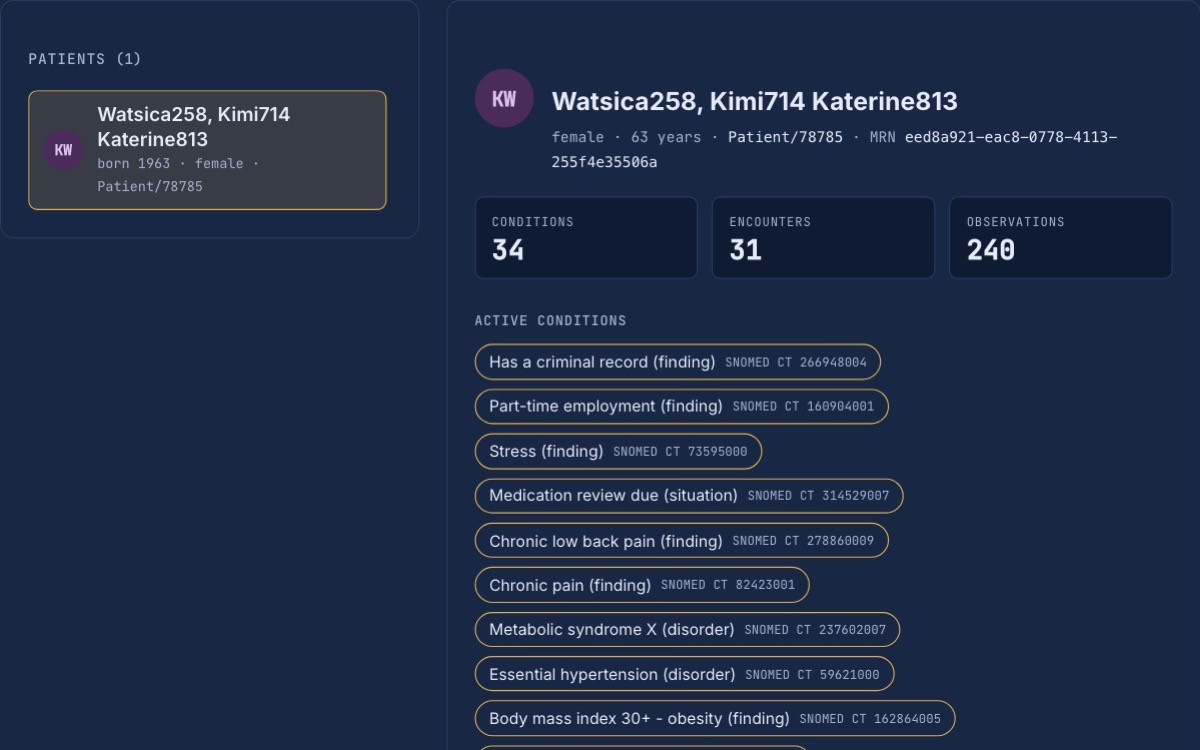
The FHIR R4 patient explorer at fhir.mvcprogrammer.com in dark mode, as it opens: the search form prefilled with the demo family name and identifier, above the panel for creating a demo patient

FHIR API

FHIR R4 patient explorer, Angular in front of C# on Lambda with the Firely SDK

A window onto a public FHIR R4 test server seeded with synthetic records. Nine operations under /api/fhir run as C# on .NET 10 on AWS Lambda, specified in the same OpenAPI document as the Experience API: five reads (patient search, summary, raw bundle, capability, and health) and four writes (create, replace, patch, and delete a demo patient) under a guard that keeps the seeded patient read-only and lets a visitor change only what their own session created. The explorer in front of them is an Angular app of its own at fhir.mvcprogrammer.com. The browser never talks to the sandbox; the function is the boundary, parsing every resource with the Firely SDK and mapping only the US Core fields to small DTOs.

Built to be polite to a shared sandbox. Every upstream call has a short timeout, retries with backoff, and a circuit breaker, and a failure comes back as an RFC 9457 problem the explorer turns into a plain message. Responses carry ETags and CloudFront caches them. No real patient data, nothing stored.

  • C# / .NET 10 on Lambda
  • Firely SDK
  • FHIR R4 / US Core
  • HAPI sandbox
  • OpenAPI 3.1
  • Polly
  • RFC 9457
  • CloudFront caching
  • Angular 22
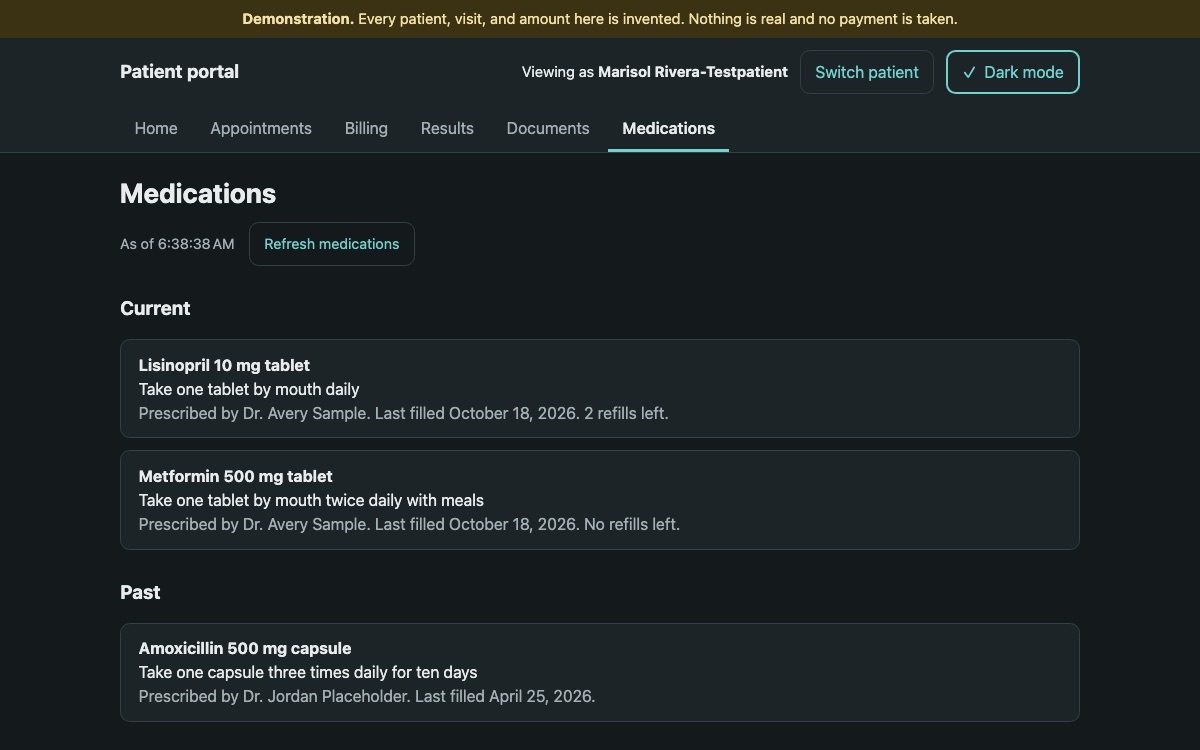
The patient portal demonstration at portal.mvcprogrammer.com in dark mode, showing an invented patient's Medications page: two current prescriptions and one past, with when the list was read

Patient Portal

Patient portal demonstration, Angular in front of C# on Lambda

A working patient portal at portal.mvcprogrammer.com. Open it as one of three invented patients, with no password, and read what a patient reads: upcoming and past appointments, a balance with its statements, test results, documents, and medications. A result the care team has not released yet says so instead of showing its numbers. Every patient, visit, and amount is synthetic.

Contract first, practice system behind an interface. The API was specified as an OpenAPI document before any code, and the tests hold the .NET 10 minimal API to it. It reaches the practice system only through a connector interface, so the in-memory synthetic connector can give way to a real one without touching an endpoint. Each view shows when it was read and when it may be refreshed, which paces calls to the system behind it, and a failure comes back as an RFC 9457 problem. Requests, messages, and payments are in the contract and ship next.

  • Angular 22
  • TypeScript
  • Signals
  • C# / .NET 10 on Lambda
  • Minimal API
  • OpenAPI 3.1
  • RFC 9457
  • xUnit
  • Vitest
  • Amazon S3
  • CloudFront + OAC
  • CloudFormation
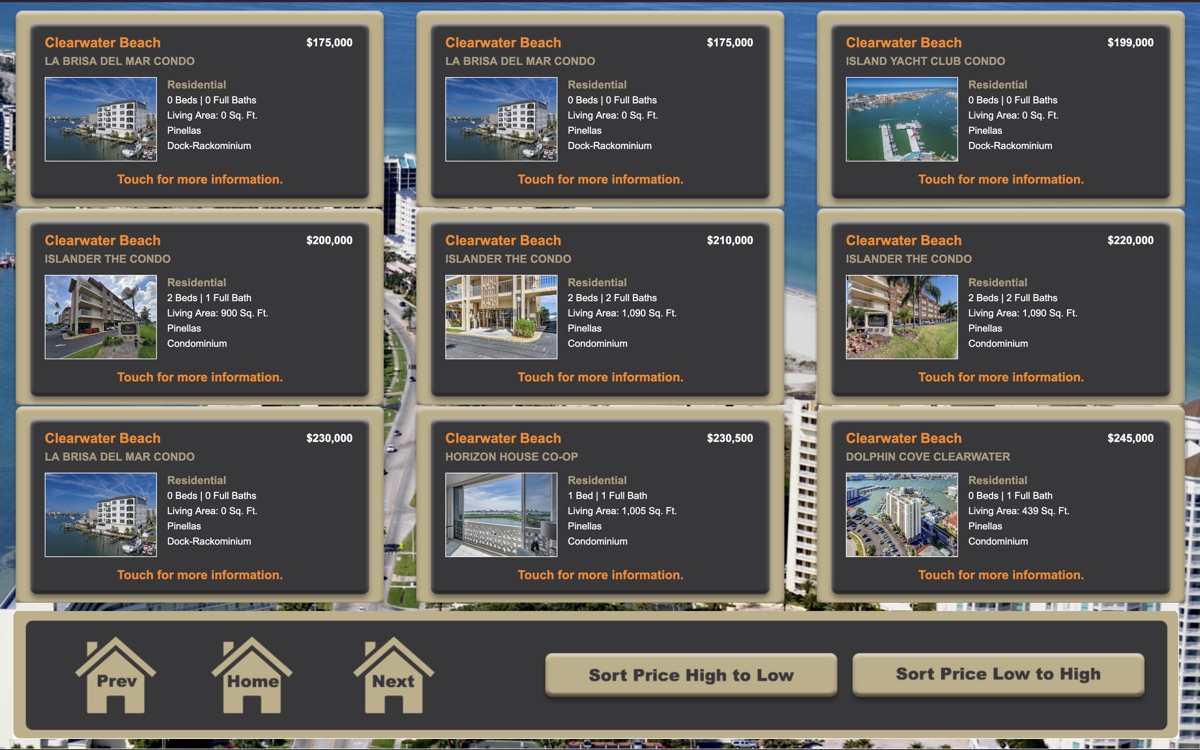
Touch-screen property search kiosk lit up in the window of a Clearwater Beach real estate office at night

Interactive Property Search Window Display

Touch screen kiosk, React + .NET on AWS

A touch-screen kiosk behind the window of a Clearwater Beach real estate office, running since 2010. Visitors pick sales or rentals over an aerial photo of Sand Key, browse live Stellar MLS listings and photos pulled through the Bridge Data Output API, and ask to be emailed details or called back from an on-screen keyboard. The 2026 rebuild is a React and TypeScript screen built with Vite, pixel-matched to the original against captures of the live kiosk, in front of a .NET 10 API on AWS Lambda served through CloudFront.

Built for 1920×1080. The screen is pixel-matched to the kiosk's fixed full-HD display and runs full screen at that resolution. In any other window it scales itself to fit, letterboxed, so the live demo below looks like the kiosk on a laptop or a phone.

  • React
  • TypeScript
  • Vite
  • .NET 10
  • AWS Lambda
  • CloudFront
  • Stellar MLS
  • Bridge Data Output API
  • 1920×1080

04 / Resume

Experience

Download resume (PDF)
  1. – · Remote

    Senior Software Engineer / Tech Lead

    AdvancedMD

    • Tech lead on the AdvancedMD Partner API (AdvancedMD Connect), the XML and REST integration API that third-party applications use to read and write practice management (PM) and EHR data.
    • Prepared API clients for production certification: reviewed third-party integrations against AdvancedMD's API requirements and guided their developers from sandbox testing to production access.
    • Advised integrators on the AdvancedMD interoperability route that fit their product: the Partner API, the FHIR R4 APIs, HL7 v2 interfaces, or reporting extracts.
    • Applied working knowledge of EHR and PM setup and workflows (scheduling, patient demographics and insurance, charge entry and billing, clinical notes, documents, lab orders) so integrations behaved the way front-office, billing, and clinical staff expect.
    • Re-architected a legacy interval-polling Windows service into an on-demand RabbitMQ pipeline, turning scheduled batch processing into event-driven real-time throughput handling 1M+ API requests 24/7.
    • Designed the publish/subscribe topology (durable queues, routing keys, consumer acknowledgment, dead-letter handling, Polly retries with exponential backoff) and scaled parallel consumers with bounded concurrency and cooperative cancellation.
    • Built and maintained HL7 v2 and FHIR integrations with external healthcare systems in a HIPAA-regulated environment.
    • Tuned SQL Server at enterprise scale on high-write integration tables: execution plans, indexing strategy, and query rewrites.
    • Owned production incident response and root-cause analysis; instrumented services with Serilog, Seq, Datadog, and CloudWatch.
    • Served two years on the AI Transition Team, bringing Claude pair programming into day-to-day development.
  2. – · Hybrid

    Software Engineer II (Full Stack)

    Arise Virtual Solutions

    • Developed full-stack features and REST API endpoints with ASP.NET Core on AWS-backed infrastructure.
    • Built asynchronous, queue-driven processing with AWS SQS and SNS to move long-running work off the request path.
    • Worked across EC2, Lambda, RDS, and S3, with CloudWatch for logging and operational monitoring.
  3. – · Florida

    Software Engineer (Full Stack)

    TOPS Software

    • Built full-stack features with Angular 2+ front ends over ASP.NET Core and ASP.NET Web API back ends.
    • Developed and maintained the company's proprietary accounting system: general ledger, receivables and assessments, vendor payables, bank reconciliation, and financial reporting.
    • Implemented CQRS with MediatR and real-time client updates with SignalR and WebSockets.
    • Took features from requirements intake through architecture review, Sprint 0, and backlog grooming; ran code reviews and mentored engineers.
  4. – · Florida

    C# Developer (Full Stack)

    LIG Marine Managers Insurance

    • Led the migration of the company platform from .NET Framework 3.x to .NET Core MVC.
    • Developed Web API services documented with Swagger, plus a WPF client built on Caliburn.Micro.
    • Maintained legacy software, expanded unit test coverage, and improved overall codebase health.
  5. – · Florida

    C# Developer (Full Stack)

    CENTURY 21

    • Now freelance: rebuilt the office’s property search kiosk in 2026 as a .NET 10 Web API on AWS Lambda behind CloudFront with a React / TypeScript touch-screen front end, serving live Stellar MLS listings and photos.
    • Developed SaaS real estate software using C# and C++.
    • Integrated Stellar MLS listing data through the Bridge Data Output API: listing search and detail endpoints, field selection, paging, photo delivery from the Bridge media CDN, and access-token handling, feeding both the SaaS product and the kiosk.
    • Managed API integrations with major external platforms including Google and Facebook.
    • Built an interactive kiosk window display application (full-screen HD, non-web target) showing live MLS listings.

Education

  1. High School Diploma

    Graduated at age 16

Continuing Education

  1. MIT OpenCourseWare

    Physics · Massachusetts Institute of Technology

05 / Contact

Let's Talk

Hiring, contract work, or a question about one of the projects above. Send a note, pick how you would like to hear back, and I will reply, usually within a day.

06 / Colophon

How This Site Is Built

A footnote for the curious. The whole site follows the KISS principle, keep it simple: there is no server behind this page, only static files on a CDN, four Lambdas, and a CloudFront Function.

Front end
I kept the front end simple: plain HTML, CSS, and vanilla JavaScript. No framework, no build step, no bundler, and no dependencies: one stylesheet, a short palette override, and one deferred script, shipped exactly as written. The Experience timeline is in the HTML, so it reads without JavaScript; when the Experience API answers, the script re-renders it from the JSON and reveals a skill filter.
Styling
Mobile-first CSS built on custom properties. Light and dark themes follow the operating system through prefers-color-scheme until a visitor picks one with the toggle beside the edition menu. A few lines of script in the head apply a saved choice before the first paint, and every color follows it through color-scheme and light-dark(). The shared palette borrows from JetBrains Rider; this edition warms it to eggshell through a small file that overrides only the design tokens with light-dark(), so no rule is repeated. prefers-reduced-motion switches off the transitions. Inter and JetBrains Mono are self-hosted as variable WOFF2 subsets and preloaded. Icons are a single inline SVG sprite.
Markup
Semantic landmarks, a skip link, ARIA labels, and visible focus rings for keyboard and screen-reader users. Search engines get JSON-LD structured data, Open Graph tags, a canonical URL, and a sitemap.
Hosting
The files sit in a private Amazon S3 bucket that only CloudFront can read, through Origin Access Control. CloudFront serves them over HTTP/2 and HTTP/3 with an ACM certificate, Route 53 aliases the domain to the distribution, and a CloudFront Function redirects www to the apex.
Security
A CloudFront response headers policy sets a strict Content Security Policy (same-origin only, no inline script or style, nothing third-party), two-year HSTS, X-Frame-Options: DENY, nosniff, and a locked-down Permissions-Policy. The site sets no cookies and runs no analytics.
Contact form
Posts JSON to an AWS Lambda function URL (Node.js 22 on arm64) that emails the message through Amazon SES. Spam is filtered before anything is sent: an origin check, a honeypot field, a minimum fill time, a per-IP hourly budget, and length caps on every field.
Resume link
The PDF is kept out of the public repository. The download button goes to a second Lambda that publishes a notification to an SNS topic, then answers with a 302 to the file in S3. If the notification fails, the visitor still gets the resume.
API integration
The work history above is served by an API at /api/experience, with a skill filter and an aggregated /api/skills view. It is C# on .NET 10, run on AWS Lambda (arm64) behind this same CloudFront distribution and reading a single DynamoDB table. The OpenAPI contract was written and committed before any code. Responses carry ETags and cache headers so CloudFront answers most requests itself, errors follow RFC 9457 problem details, and the function URL accepts only requests signed by CloudFront. Write endpoints are specified and stubbed for an admin API to come. The contract is public: OpenAPI spec.
Healthcare demo
The FHIR API card in Selected Work opens the live FHIR R4 patient explorer at fhir.mvcprogrammer.com, an Angular app of its own, in the same native <dialog> the kiosk demo uses: main.js creates the iframe when a demo button is pressed and removes it on close, so the explorer and the C# Lambda behind it load only when a visitor asks. The function reads a public sandbox of synthetic records through the Firely SDK, maps the resources to small DTOs, and reports every upstream call so the explorer can show what happened; its write side creates, replaces, patches, and deletes demo patients under a guard tied to the visitor's session. Nothing is stored, and no real patient data is involved.
Deploys
A GitHub Actions workflow runs on every push to main. It assumes a least-privilege IAM role through OIDC, so no AWS keys are stored in GitHub, runs aws s3 sync --delete in two passes (a week of browser caching for fonts and images, five minutes for pages), and invalidates the CloudFront cache. The third-party actions are pinned to commit hashes.
Tooling
Written in JetBrains Rider with Claude Code as a pair programmer, and previewed locally with python3 -m http.server before each commit.
Read the source on GitHub

Live demo

Interactive Property Search Window Display

The real kiosk at display.lightsplitters.com, scaled to fit this window. Touch or click around; it returns to its lock screen after three minutes idle, like the one behind the glass.

Open full size in a new tab

Live demo

FHIR R4 Patient Explorer

The explorer at fhir.mvcprogrammer.com, an Angular app in front of the C# FHIR API. Search the sandbox, pick a patient, and watch every upstream call in the log.

Open full size in a new tab